
Shipping Economics
How 3PLs Protect Parcel Margin When Carrier Rates Rise
Carriers post a general rate increase every year, and parcel margin erodes on a lag while you reprice. The operational fix: markup that references the live carrier rate, accessorials included.
How 3PLs Protect Parcel Margin When Carrier Rates Rise
Margin protection is keeping the spread between carrier cost and client price intact when a carrier rate increase hits. Most 3PLs set a markup once, then lose it back a few cents at a time every time UPS, FedEx, or USPS reprices. This is the operational fix.
What does protecting parcel margin from a rate increase actually mean?
Margin protection is holding that spread when the carrier's number changes. It is one lever in the broader work to increase 3pl margins, and it is not about picking the markup in the first place — that is a separate question about how much to mark up shipping. It is about what happens to that markup the morning a carrier rate increase takes effect.
The failure mode is quiet. You set a client's parcel pricing in a spreadsheet or a billing system, the carrier posts a rate increase, and for the weeks it takes to reprice, you bill last quarter's price against this quarter's cost. Nobody sees a wrong invoice; the margin just thins.
Protecting it means closing that gap structurally instead of chasing it four times a year. If you are still deciding how the parcel line sits inside your overall pricing, start with 3pl pricing strategy and come back — this page assumes the markup exists and the job is to defend it against every carrier rate increase.
Why a rate increase quietly erodes your margin
Carriers change prices on a schedule you do not control. UPS and FedEx each posted a 5.9% average general rate increase (GRI) for 2026 — effective December 22, 2025 and January 5, 2026 respectively. USPS moves on its own cadence: competitive shipping prices rose in January 2026, then a time-limited 8% increase hit Ground Advantage and other retail and commercial shipping rates from April 26, 2026.
The headline percentage is almost beside the point. What causes margin erosion is the mechanism most 3PLs use to respond. Client prices live as stored numbers, so when the carrier rate moves, none of them move on their own.
Your team pulls the new tables and re-enters pricing for every client — and for a shop with 30 or 40 accounts, that is days of work spread across the weeks after the increase lands. During that reprice lag, every label bills at the old price against the new cost. A few cents across your whole volume, at every carrier rate increase, four times a year, is real money nobody decided to give away.
Markup that references the live carrier rate
The durable fix is to stop storing prices and start storing rules. Rate markup automation means your client price is a rule applied to the current carrier rate at the moment the label prints — not a value someone typed in last quarter. When the carrier rate changes, the rule does not. The new price flows through the same day, with no reprice project and no lag.
Markup that moves when the carrier does
Advanced Rate Markups applies your per-client logic to the live carrier rate as each label prints — a GRI flows through the same day, no reprice project.
This is the whole point of Advanced Rate Markups: margin you can see and control. You configure the markup logic per client once, and it applies against the live carrier rate as each label prints. The corporate-pricing habit worth breaking is a percentage markup sitting on a stored rate — that is the version that erodes silently at every increase. Rate markup automation bound to the live rate is what turns a carrier rate increase from a fire drill into a non-event.
Don't forget the accessorials
A carrier rate increase is not just the base transportation number. Fuel, additional handling, residential, and peak surcharges move too — and they are a large and growing share of the bill. In the ShipScience Q2 2026 index (vendor data, 124M+ shipments), accessorials were 33.3% of UPS parcel spend and 41.9% of FedEx parcel spend for shippers in the sample in April 2026.
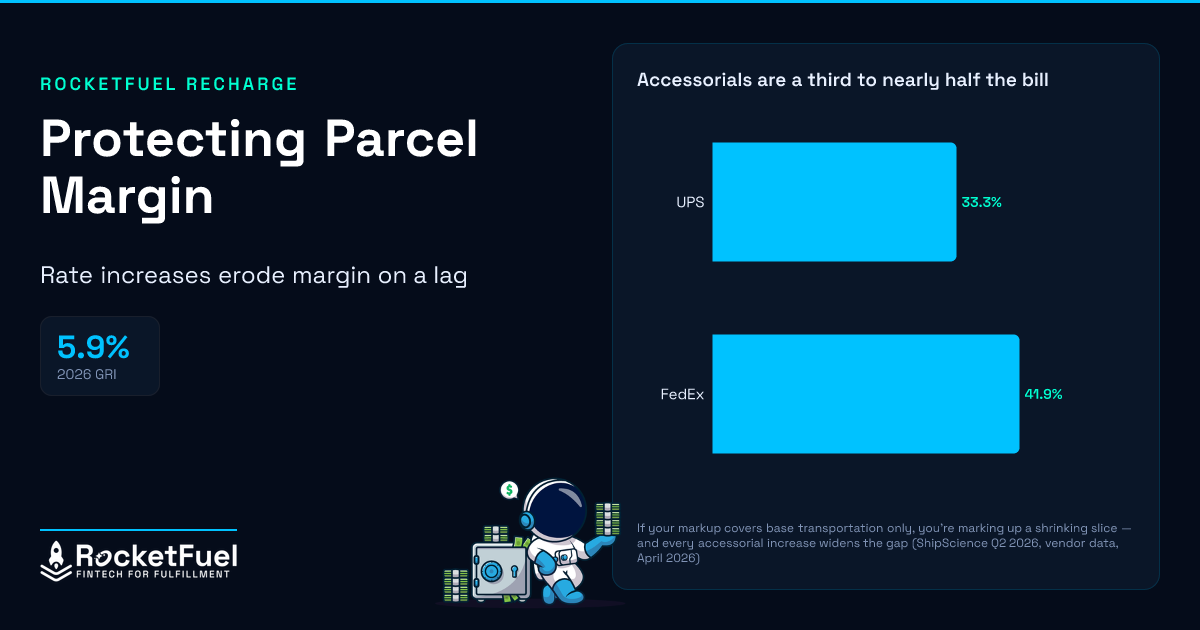
If your markup applies only to the base rate and accessorials pass through at cost, you are marking up a shrinking slice of the invoice — and every surcharge increase widens the gap. Protecting margin through a rate change means the markup logic covers accessorials, not just base transportation. Pass the surcharges through with the markup applied, or you defend one number while the carrier raises the other.
See the erosion before day 35
Good markup logic sets the price. It does not, on its own, tell you whether the margin actually held — and for most operators that answer arrives 35 days late, after carrier invoices land and reconciliation finishes. By then a client that went upside-down after a rate increase has been upside-down for over a month.
Margin protection has a visibility half: real-time, per-client margin, per carrier and per service level, so an increase that slips through shows up this week, not next month. That is the difference between defending margin and auditing its loss after the fact.
One thing worth stating plainly, because fintech usually muddies it: when a client funds a prepaid balance and each priced shipment meters against it, the funds ACH directly to your bank — money never sits with RocketFuel Recharge. You keep custody and float; the platform is the metering and billing layer.
If you want to see the reprice-lag math on your own volume, book a demo.
FAQ
How do you deal with a general rate increase without losing margin?
Stop pricing off a stored number. If client prices are markup rules applied to the live carrier rate, a general rate increase flows through automatically the day it takes effect — no repricing project, no lag. Operators who hard-code prices eat the gap for the weeks it takes to reprice every client. Rate markup automation removes both the labor and the leak.
What is margin protection for a 3PL?
Keeping the spread between carrier cost and client price intact when the carrier's rate changes. It is distinct from setting the markup level in the first place — protection is about defending an already-set margin through a carrier rate increase, accessorial hikes, and the reconciliation lag, rather than letting it thin a few cents at a time.
Does a parcel markup need to cover accessorials?
Yes. With accessorials running a third to over 40% of the carrier bill (ShipScience Q2 2026, vendor data), a markup that applies to base transportation only is marking up a shrinking share of the invoice. Confirm your markup logic applies to surcharges too, or margin erodes every time a carrier raises an accessorial rather than the base rate.
More in Shipping Economics
Written for the party that re-bills what it buys: the levers a 3PL has that a single shipper does not, what to ask for first, and what the carrier will ask you to trade for it.
Shipping Economics · 6 min read The delivery area surcharge you could not have quoted forWhy the delivery area surcharge is the hardest accessorial for a 3PL to bill correctly, how to catch a reclassification yourself, and four ways to handle it in client billing.
Ready when you are
See it run on your operation.
30-minute live demo. We'll walk your billing model against the Recharge Meter and run the math on your last 90 days.
- Live demo, not a sales deck
- We run your last 90 days
- Built by 3PL operators